
You Don't Need More Willpower
You need structure that doesn't collapse under pressure.
Somewhere along the way, ambitious people inherited a belief that achievement is a function of effort. Try harder. Want it more. Push through. And for a while, that works. Until it doesn't.
The goals you've abandoned weren't failures of character.
They were failures of design.
The Pattern
You set a goal that mattered. The first few weeks felt focused, even energizing. You had clarity. You had momentum. And then, somewhere between week three and month two, the whole thing started to drift.
Not because you stopped caring. Not because you gave up. But because your calendar filled up. A project demanded more of your attention. Your energy dipped. And the goal that felt so clear at the start slowly got buried under the weight of everything else.
And unfortunately, this likely isn't the first time.
But here's the part that's harder to talk about: each time it happens, the next attempt feels a little less credible. Not because you've lost ambition. Because there's a persistent voice in the back of your mind asking whether this time will be any different.
The Cost of Doing This Again
Every high performer has a finite number of times they can set a meaningful goal, watch it drift, and recover their full faith in themselves afterward.
- Quick rebound
- "Wrong timing, wrong season"
- Announced widely
- "This year"
- Quiet hesitation
- Held more loosely
- Shared with fewer
- "Someday"
Not because you don't care. Because part of you is protecting the part that's tired of watching itself stop.
That's the real cost. Not the goal you didn't achieve. The erosion of self-trust that comes from repeating the pattern.
And it compounds invisibly across years.
What's Actually Happening
Most people assume goal failure is a motivation problem. That if they just cared enough, tried harder, or stayed more disciplined, the goal would stick.
That's almost never the real issue.
Goal-setting is one of the most studied and validated mental skills in performance psychology. The research is not in question. Goal setting works.
So if the tool works, why does it keep breaking in practice?
Because most goals are structurally incomplete. They're built to inspire, but they aren't built to hold up when real-world conditions change. They rely on willpower to close the gap between where you are and where you want to be. And willpower is finite.
An executive sets a goal in January that genuinely matters, maybe it's finishing the book, rebuilding a fitness practice, leading differently at work. The first few weeks are clean. Then a stretch of travel hits. The goal gets shelved for "next week." Next week becomes next month. By April, they can't quite remember when they stopped, and the whole thing feels further away than it did when they started. They've done this five times before. Each time with a slightly different goal. Each time with the same ending.
That's not a discipline problem. That's a design problem.
And once you can see it, you can fix it.
The Reframe
Willpower isn't the problem.
But it's the wrong tool.
Willpower is what you use when the system isn't built yet. It's what fills the gap when there's no architecture carrying the weight. The problem isn't that ambitious people don't have enough willpower. It's that they've been taught to rely on it as the primary mechanism, when it was only ever meant to be a backup system.
Goals don't fail people. Incomplete systems do.
When you replace willpower with structure, daily decisions get simpler because the system is guiding them. The goal stops being something you're chasing and starts becoming something you're building toward with steady, visible progress. You don't have to force consistency. The architecture produces it.
If that sounds like the way you want to operate, keep reading. The rest of this page describes what that looks like in practice, and what it takes to get there. If you already know this is the shift you want to make, you can start below.
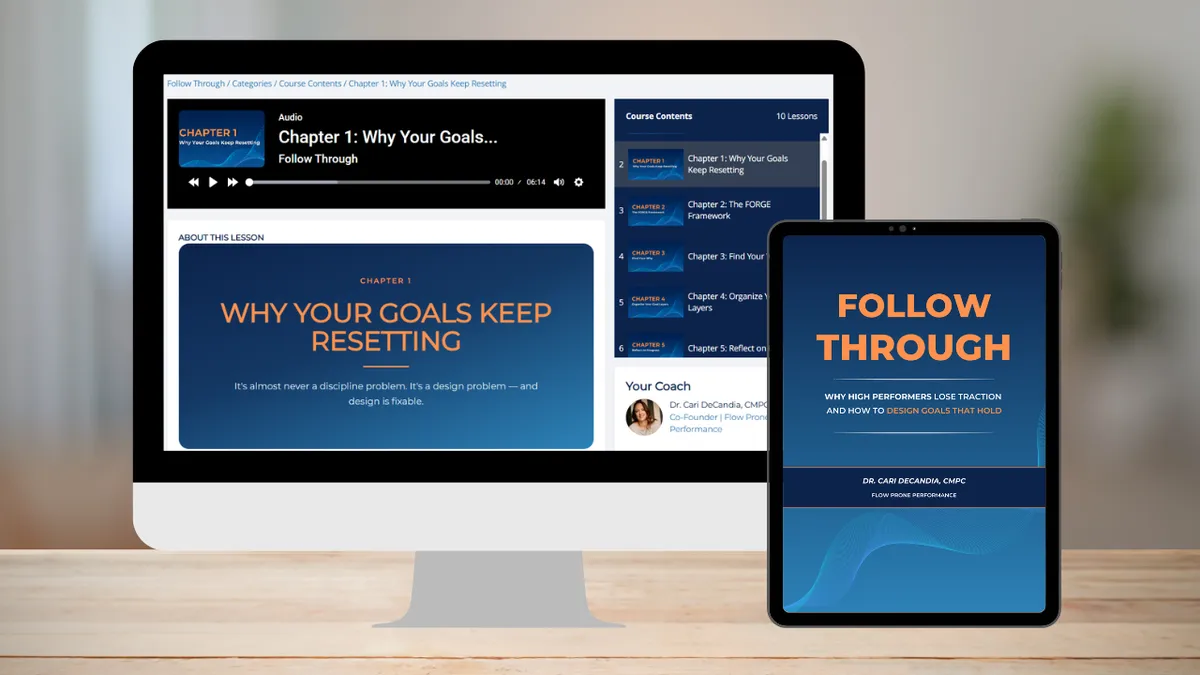
What You're Actually Getting
Follow Through isn't a goal-setting book in the way that phrase usually gets used. It's a structural operating system for how ambitious people pursue the things that matter to them, whether that's this year's revenue target, the health practice you keep abandoning, the way you want to show up as a parent or partner, a creative project that's been sitting untouched for years, or the version of yourself you want to grow into over the next decade. Work. Health. Relationships. Identity. The kinds of pursuits that don't fit neatly into a productivity framework but shape what your life actually looks like.
The specifics don't matter. What matters is whether the system underneath them can hold.
When you work through this book, you walk away with four things most ambitious people have never built:
A way of operating that doesn't require muscling through every week.
The system carries the weight, not your willpower.
A clear sense of whether you're actually making progress, week to week.
No more waiting for a quarter to end to find out you drifted.
A plan for the hard moments before they arrive.
Friction becomes something you move through, not something that stops you.
A daily practice that raises your baseline across everything.
Not just what you're pursuing now. Everything you'll set out to build from here forward.
Most people rely on willpower to close the gap between where they are and where they want to be. What you build in this book is the architecture that closes the gap for you. The pursuit stops being something you're chasing. It becomes something you're building toward, with daily traction you can see and trust.
It's the same framework I use with executives and founders in 1:1 coaching. The version in this book is self-directed, which means the pace is yours. The system is the same one that's held up for high performers across years of real-life volatility.
What the System Actually Produces
By the time you finish this book, you'll have something most frameworks don't leave you with.
A working system. Not a theory.
Built piece by piece, designed to work as one integrated system.
Not concepts you understood and forgot. An integrated system you can actually run.
How This Works
When you buy, you get immediate access to three things.
The material is designed to be engaged with twice. First for understanding, then for building. You're free to move through it at whatever pace and sequence works for your life.

Who Wrote This
I'm Cari. I hold a doctorate in performance psychology and have spent more than two decades studying what actually makes high performance sustainable, not in theory, but in the lives of people operating at the top of their fields. Over that time, I've worked with hundreds of leaders and elite performers across both business and sport. Executives rebuilding how they operate at the top of their careers. Athletes performing under the highest possible stakes. Founders trying to build something meaningful without losing themselves in the process.
When you study high performance across that many people for that long, patterns start to emerge. The same structural elements show up in the lives of the people whose goals hold, and the same gaps show up in the lives of the people whose goals don't.
FORGE was developed from those patterns. It's the framework I use in 1:1 coaching with executives and founders, and it's what I've seen hold up across years of real-life volatility in the people who run it. The research told me that goal setting works. Experience told me it only works when specific structural elements are in place. This book is how I teach those elements in their simplest form.

What Follow Through Is Not
This isn't a motivation book. There's no morning routine template. No promise that you'll wake up transformed. No claim that a specific app, planner, or productivity stack will change your life.
This is a book about how to build goals that actually hold. It's written for people who have set meaningful goals before and watched them fall apart, not because they didn't care enough, but because the structure underneath them wasn't there. It's written for people who are tired of the willpower paradigm and suspect there's a better way to operate.
Transformation in 30 days.
Success as a mindset problem.
This isn't it.
Structure that outlasts motivation.
Systems that hold up when life does what life does.
You're in the right place.
What This Looks Like When It's Working
Picture what it would feel like to set a goal and actually trust the system behind it.
Not because you've suddenly become more disciplined.
Because the goal is connected to something that genuinely matters to you.
Because you can see your progress through clear milestones rather than guessing.
Because you have a rhythm of reflection that catches drift before it compounds.
Because when obstacles show up, you've already rehearsed the response.
And because your daily operating baseline is supported by a habit that makes everything else easier.
That's a fundamentally different experience than setting an exciting goal in January and watching it drift by March. Not because you didn't care, but because the structure wasn't there to hold it.
The goals you've abandoned in the past weren't failures of character.
They were failures of design.
And you can redesign the process.
If This Doesn't Hold For You
If you build the system and it doesn't hold, email us and we'll refund you. No forms. No justification. No friction.
That's a real offer, not a sales tactic. If this isn't the right fit for where you are, I'd rather you keep the $27 than keep the book.
You don't need more willpower.
You need structure that holds.
Email us at [email protected]