Flow States and Football: The psychology of reaching "the zone"
Author: Dr. Jon Beale
Scroll down for an invitation to join a live masterclass with the world’s leading expert on flow in sports, this Thursday.
I train and coach people to reach peak performance states. The past 11 days, however, I’ve been in training for peak couch potato state.
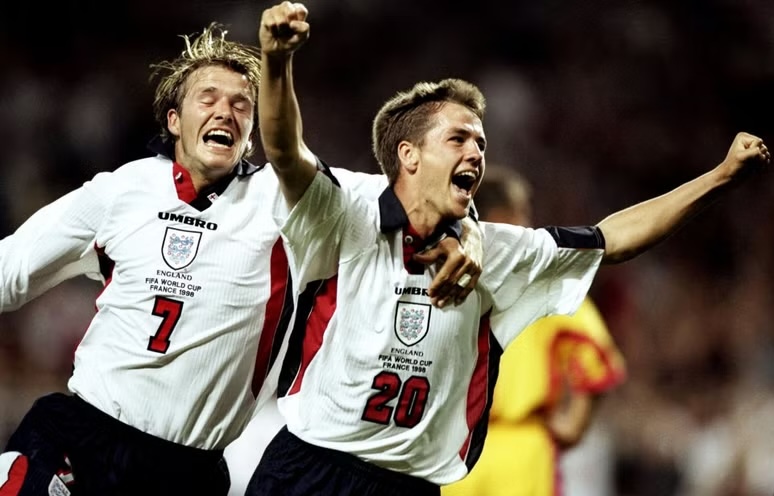
It’s the World Cup, which means: a lot of TV. Every England match, every set of highlights, and the occasional neutral match for good measure – Saturday night it was Germany v Côte d’Ivoire. I’ve even revisited great World Cup moments on YouTube, like that incredible goal Michael Owen scored when we played (ahem, got knocked out by) Argentina in France ‘98. By writing pieces like this I can almost convince myself this is "research."
While many of us master peak couch potato state over the next four weeks, we’ll watch many of the world’s best footballers enter a completely different state: "the zone." This emerges after an initial period of strenuous effort, where an athlete’s skills are exerted to their limit to meet a challenge. Following this, an altered state of consciousness sometimes emerges, where it feels like everything is going perfectly and nothing can go wrong. You execute every pass, shot, dribble and tackle with textbook accuracy.
Yet, while you’re stretched to the edge of your ability and performing at your highest level, it no longer feels as if you’re trying to do so. You feel a stronger sense of control, but what you’re doing feels effortless. Your actions and awareness merge into one. You stop thinking about what you’re doing, and just do. Everything else fades from consciousness. You don’t have to try to stop being distracted, because it’s no longer possible for your mind to wander. You’re fully present in the moment.
When you emerge from this trance-like state, you wonder what the hell just happened. Time seemed to stop. An hour passed in what felt like ten minutes. You somehow performed at your best without having to think about what you were doing. It was as if you were one with the world, doing without thinking. Just being.
This is the kind of experience known as a "flow state." It’s the state of optimal experience, where we become completely immersed in an activity. It most often arises when we engage in a challenging activity that stretches our skills to their limit. This forces us to completely concentrate on the activity.
There are several types of flow state. When we reach the zone playing a sport, we experience flow as a state of optimal performance, which I call ‘performance flow’.
Flow experiences are among the highlights of our lives. In flow we often reach our creative, cognitive or physical peak. We become so immersed in what we’re doing that we switch off from stress, stop ruminating and dwelling over negative thoughts. Our worries fade away and our inner critic falls silent.
These are among the reasons why experiencing flow frequently has striking benefits for our health, well-being and performance. It’s a core component of human flourishing.
How to Reach ‘The Zone’
Flow states were first identified in the mid-1970s by the Hungarian psychologist Mihaly Csikszentmihalyi. Through interviews with over 10,000 people – including artists, musicians, dancers, writers, athletes, climbers, martial artists, scientists, surgeons, chess players and more – he identified the conditions common to flow experiences. Many of them reported reaching their creative, cognitive or physical peak when they experienced flow. Their ideas and actions felt like they were flowing out of them. They were one with their activity, in flow with it.
A quote Csikszentmihalyi cites in his 1990 book Flow from a dancer he interviewed nicely captures what flow feels like:
"Your concentration is very complete. Your mind isn’t wandering, you are not thinking of something else; you are totally involved in what you are doing."
To reach performance flow, we need to engage in challenging activities that exert our skills to their limit. ‘Flow’, Csikszentmihalyi wrote, ‘tends to occur when a person’s skills are fully involved in overcoming a challenge that is just about manageable’ (Flow, p. 74). He called this sweet spot the "flow channel," and visualized it as follows:
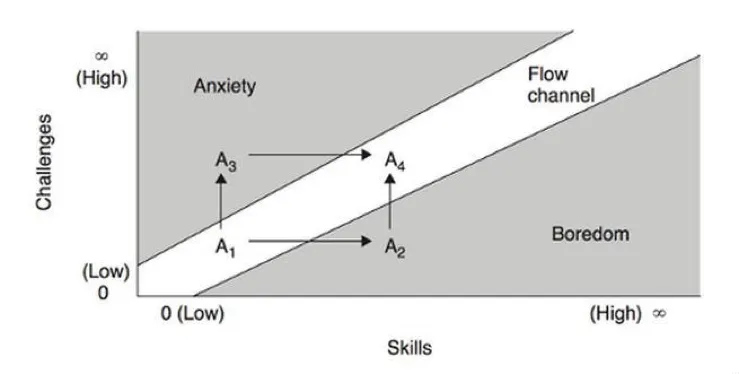
Imagine a reserve team footballer. They’re consistently pushed to the edge of their comfort zone while playing for the reserves. They frequently experience flow. They’re in the position of A1.
The coach recognises their consistent high performance and gives them a shot in the first team, coming on as a substitute. They’re anxious as they make their first team debut. The anxiety takes up some of their working memory capacity, leaving them with less available to focus on the task. The challenge exceeds their skills, and they don’t experience flow. They’re in the position of A3.
After a few matches, the coach decides the player needs to work more on their skills before potentially playing for the first team again. The player returns to playing with the reserves, but their skills have advanced and they have a greater drive to prove to the coach, players and fans that they’re capable of playing with the first team. They practice more and with greater determination, so their skills improve faster. They perform much better than the other reserves, but no longer need to exert their skills to maximum capacity. They become bored, and their mind wanders. They’re no longer in flow. They’re in the position of A2.
The coach gives them another shot in the first team. Now, with greater confidence and skills, they can keep up with the more demanding level. The challenge is no longer unmanageable; it’s just about manageable. They become completely absorbed when playing with the first team, often reaching the zone. They’re in the position of A4. They’re back in flow.
Join this week’s masterclass with the world’s expert on flow in sports
Understanding flow is one thing, but learning how to build the skills to reach it more often is another. I’ll explore exactly how this Thursday, with the world’s leading expert on flow in sports, psychologist Dr. Sue Jackson.
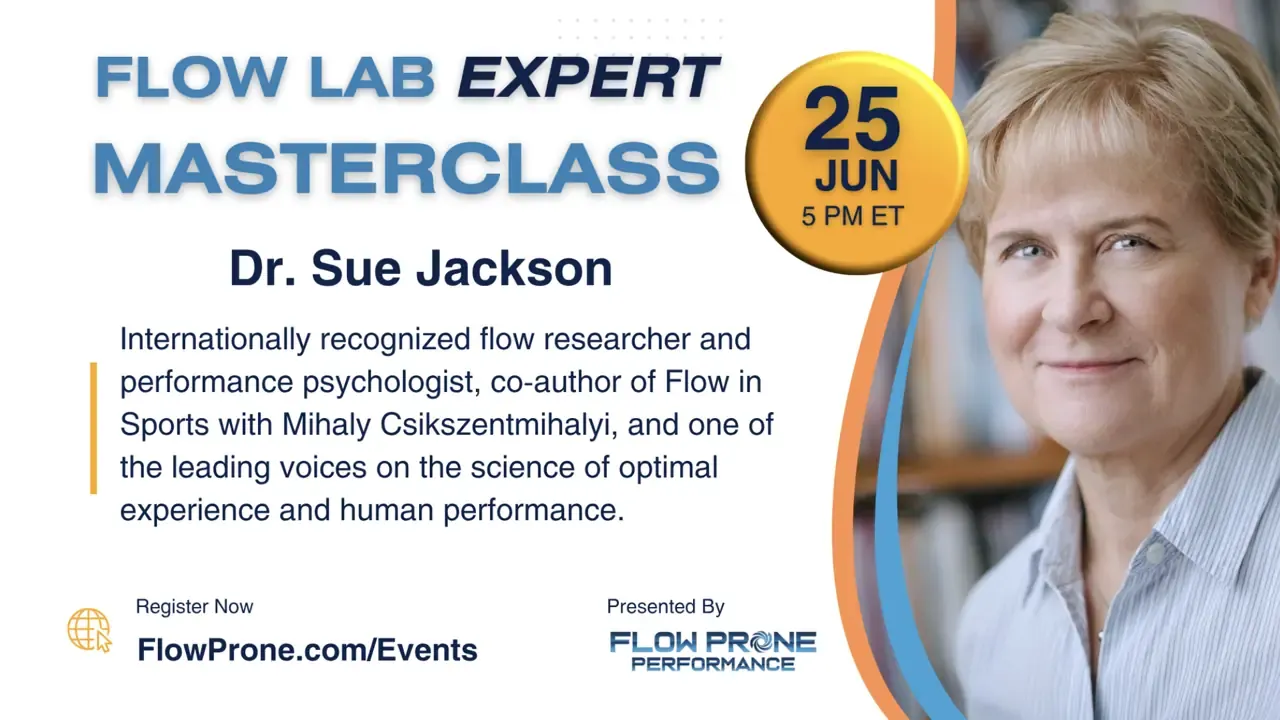
Sue co-authored several articles and the book Flow in Sports with Csikszentmihalyi. She’s conducted groundbreaking research on flow, including developing several validated scales for measuring flow which are used worldwide in scientific studies today. She has a wealth of experience working with individuals in high performance domains, including athletes, medical doctors, executives and artists.
Here’s a recent video Sue posted about flow and football:
We'll discuss how we can build the skills to reach flow deeply and frequently, not only in sports but throughout our lives, this Thursday, 25th June, 5-6pm ET, over Zoom.
We’ll start with a fireside chat and then open up the floor for audience questions. You’ll come away with practical ways to build more flow into your own work and life. Learn more here.
drjonbeale.com | @drjonbeale